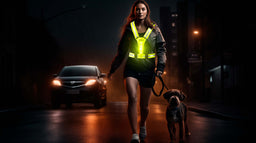


Pedestrian Fatality Data, Visibility Science, and What It Means for Your Safety
Most people who walk, run, or cycle after dark know it’s “not as safe” as doing it during the day. It’s common sense. But very few people understand just how dramatic the risk difference is, or why. The data tells a story that’s both alarming and empowering: alarming because nighttime pedestrian deaths have reached crisis levels in the United States, and empowering because the single most effective thing you can do about it — making yourself visible — is simple, affordable, and backed by hard science.
This article lays out the numbers as clearly as we can. No scare tactics, no exaggeration. Just the data, what it means, and what you can do with it.
The Pedestrian Fatality Crisis: Where We Stand
In 2024, an estimated 7,148 pedestrians were struck and killed by drivers in the United States, according to preliminary data from the Governors Highway Safety Association (GHSA). While that number represents a 4.3% decline from 2023 — the second consecutive year of modest improvement — it remains nearly 20% higher than the 5,997 pedestrians killed in 2016. And it follows a devastating peak in 2022, when pedestrian deaths hit a 40-year high.
To put that in perspective: between 2009 and 2023, pedestrian deaths rose 80%. During that same period, all other traffic fatalities increased just 13%. Pedestrians are dying at a rate that far outpaces every other category of road death.
This isn’t a gradual trend. It’s an acceleration. And the single biggest factor driving it is darkness.
76% of Pedestrian Deaths Happen in the Dark
According to NHTSA data, more than three-quarters of all pedestrian fatalities — 76% — occur when it’s dark outside. Another 4% happen during dusk or dawn, those transitional periods when visibility is dropping but many people haven’t yet adjusted their behavior.
The nighttime share of pedestrian deaths has been growing disproportionately. Between 2010 and 2023, fatal pedestrian crashes at night surged 84% — rising from 3,030 to 5,578 per year. During daylight hours, the increase was 28%. Darkness isn’t just a factor in pedestrian fatalities; it’s the dominant factor, and it’s getting worse.
The timing pattern is striking. NHTSA reports that 25% of all pedestrian fatalities happen between 6:00 PM and 8:59 PM, and another 26% between 9:00 PM and 11:59 PM. These aren’t the middle-of-the-night hours when few people are outside. These are the early evening hours when millions of Americans are walking their dogs, finishing a run, heading home from work, or walking to their car after dinner. It’s the most normal, routine time to be a pedestrian — and the most dangerous.
Why Darkness Is So Deadly: The Physics of Visibility
Understanding why nighttime is so dangerous requires understanding how visibility works from a driver’s perspective. It’s not just that it’s harder to see in the dark. It’s that the gap between what pedestrians think drivers can see and what drivers actually can see is enormous.
A pedestrian wearing dark clothing on an unlit road is typically visible to a driver from about 55–80 feet away. At 40 mph, a car covers that distance in roughly one second. The average driver’s reaction time is 1.5 seconds. Do the math: by the time a driver’s brain registers a dark-clothed pedestrian, it’s already too late to stop.
Now compare that to a pedestrian wearing an LED vest or active lighting. Visibility jumps to 500 feet or more. At 40 mph, that gives a driver over 8 seconds of reaction and braking time. The difference between 80 feet and 500 feet of visibility isn’t incremental. It’s the difference between life and death.
Research confirms this. Proper visibility gear has been shown to increase driver detection distances from under 100 feet to over 500 feet — roughly a 6x improvement. And a landmark randomized trial in Denmark involving nearly 7,000 cyclists found that wearing conspicuity-enhancing gear reduced motor vehicle collisions by 55%.
The Visibility Perception Gap
Here’s one of the most dangerous findings in pedestrian safety research: people massively overestimate how visible they are to drivers at night.
In one study, cyclists overestimated their nighttime visibility by more than 50%, believing drivers could see them from much farther away than they actually could. Pedestrians show the same bias. If you’ve ever thought “I can see the cars, so they can see me,” you’ve experienced this perception gap firsthand.
The problem is asymmetry. You can see a car’s headlights from a quarter mile away because those headlights are projecting 50,000+ candela of light directly at you. But the driver behind those headlights is scanning a wide field of view, processing dozens of visual inputs simultaneously, and looking for you in a narrow cone of light that may not even reach you if you’re on the roadside or in a crosswalk outside the headlight beam pattern.
You are not nearly as visible as you feel. This perception gap is one of the main reasons people don’t bother with visibility gear — they don’t think they need it because they don’t realize how invisible they actually are.
Hit-and-Run: The Hidden Epidemic
One in four pedestrian fatalities involves a hit-and-run, where the driver flees the scene. Over the past five years, 25% of fatal pedestrian crashes have been hit-and-runs, and in 94% of those cases, the striking vehicle was the one that fled.
Hit-and-runs are disproportionately nighttime events. Low visibility means the driver may not even realize what they hit, or may panic precisely because the collision was sudden and unexpected. Active lighting doesn’t just help a driver see you in time to stop — it also makes the encounter unambiguous. A driver who clearly sees a lit-up pedestrian from 500 feet away is far less likely to collide and far less likely to flee if a collision does occur.
The Infrastructure Problem
Nearly two-thirds of pedestrian fatalities occur in locations without a sidewalk. Since 2017, deaths in areas lacking sidewalks have risen by 1,164 compared to just 167 in areas with sidewalks. Light trucks (SUVs, pickups) now account for 54% of pedestrian fatalities where a vehicle type is known, up from a much smaller share a decade ago. Larger vehicles have larger blind spots and longer stopping distances.
These infrastructure and vehicle trends are real, and they’re important context. But they’re also things you can’t control. You can’t add a sidewalk to your street. You can’t shrink the SUV approaching you. What you can control is whether that driver sees you from 500 feet away or 80 feet away. Visibility gear doesn’t fix the infrastructure problem, but it gives you a critical layer of protection within a system that wasn’t designed with your safety in mind.
What the Science Says About Active Lighting
The evidence for wearable active lighting is strong and growing. Here are the key findings from peer-reviewed research:
Detection distance: Pedestrians with active LED lighting are detected by drivers at 500+ feet, compared to under 100 feet for dark clothing. This gives drivers 5–8 additional seconds of reaction time at typical urban speeds.
Biomotion effect: Lights placed on moving limbs (arms, legs, ankles) are detected at distances up to 10 times greater than lights placed on the torso alone. The human visual system is extraordinarily sensitive to biological motion patterns, making moving lights far more conspicuous than stationary ones.
Collision reduction: A randomized controlled trial of nearly 7,000 cyclists in Denmark found that conspicuity-enhancing jackets reduced the overall risk of collisions by 47%, with a 55% reduction in motor vehicle collisions specifically. A separate New Zealand case-control study found a 37% lower crash risk for riders using reflective or fluorescent gear.
Flashing vs. steady: In urban environments with many background lights, flashing lights are significantly more effective at attracting driver attention because they stand out from the steady ambient glow. In rural areas with no background lighting, steady and flashing are equally detectable.
Combination is king: The most effective visibility strategy combines active LED lighting with retroreflective materials. Active lights work beyond headlight range (intersections, side streets, parking lots). Reflective materials are highly effective within headlight range. Together, they cover every scenario.
What This Means for You
If you walk, run, or cycle after dark — even on well-lit streets, even in a neighborhood you know well, even for just 10 minutes — the data is unambiguous: you are at significantly elevated risk, and that risk drops dramatically with proper visibility gear.
The 76% nighttime fatality rate doesn’t distinguish between careful people and careless people. It doesn’t care whether you’re on a sidewalk or a shoulder. It reflects a systemic visibility problem: drivers cannot see pedestrians well enough, quickly enough, consistently enough to avoid all collisions.
The good news is that the solution is one of the simplest and most cost-effective interventions in all of traffic safety. A rechargeable LED vest or chest light that costs $25–$35 and takes 10 seconds to put on can increase your visibility by 6x and reduce your collision risk by nearly half.
At Avanto Safety, we build visibility gear because we believe this gap between the size of the problem and the simplicity of the solution is too wide. Thousands of people are dying every year in collisions that better visibility could prevent. That’s not an opinion. It’s what the data shows.
Key Takeaways
• 7,148 pedestrians were killed by drivers in the U.S. in 2024. Pedestrian deaths have risen 80% since 2009.
• 76% of pedestrian fatalities occur after dark. Fatal nighttime pedestrian crashes rose 84% between 2010 and 2023.
• 51% of all pedestrian deaths happen between 6:00 PM and midnight — the most routine hours for evening activity.
• Visibility gear increases detection distance from ~80 feet to 500+ feet, giving drivers 5–8 extra seconds to react.
• Conspicuity-enhancing gear reduces motor vehicle collision risk by up to 55% in controlled studies.
• The most effective strategy combines active LED lighting with reflective materials on both the torso and limbs.
See Avanto Safety’s full range of LED vests, chest lights, and reflective sashes at avantosafety.com. All products feature USB-C charging and IPX5+ water resistance.